

Sustainable Campus, Anyone? (Part 1: The List)
Posted by: owleyes333 / Category: campus, Environmental Science BIO 36, sustainabilityI am a quiet person. I keep to myself and I only come on campus when I need to. I am not part of any clubs here, and I have little to no school pride. I know are what credits I need to get out of this place and that’s about it. It may be sad, but that’s just how things are. So when I was informed of this blog assignment, I was scared. My sustainability knowledge is recent and my knowledge of this school is nonexistent. So how am I to do a blog concerning both? Answer: research. Lots and LOTS of research. And at the end of all of that, I found this:
 |
| Picture courtesy of Climate Champions http://www.sustainablecampus.org.au/ |
A Basic Campus Sustainability Outline
This outline takes apart main aspects concerning a campus’ sustainability and focuses on those aspects’ individual improvement toward sustainability. These main aspects include: buildings, energy, procurement, transport, waste and water.
With this in mind, I decided to compare RCC to other campuses and their sustainability factors for each of these main aspects, as well as list on how each could be improved upon. This is what I have concluded:
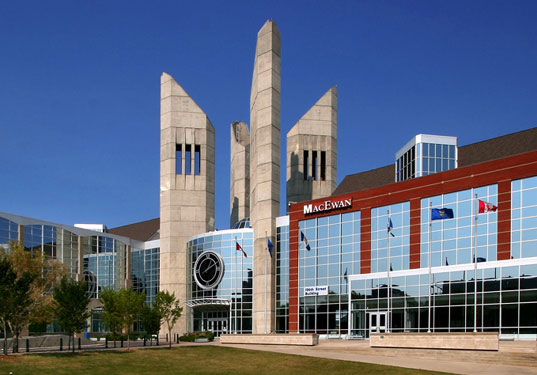 |
| Picture courtesy of Grant MacEwan University http://inhabitat.com/grant-macewan-university-science-center/ |
According to the DTI regulations, in order to have a sustainable campus, the buildings must achieve maximum efficiency; maximum user health, satisfaction, and productivity; and minimum whole life cost.
According to the Grant MacEwan University website, "In May 2011, Grant MacEwan University announced the opening of its University Service Center in Canada, the first phase of its Single Sustainable Campus initiative. Built to LEED Silver Standards, the USC features natural lighting, low VOC materials, water conservation measures and a solar-reflective roof, among other sustainable actions. The building's energy performance was also optimized to reduce consumption by an impressive 40%."
Is RCC even close to this? Not really. The RCC campus was built around 1916, and has been serving students for decades since. Although it may be true that keeping an old campus may have its benefits (since some newly remodeled campuses are not as eco-friendly as older campuses), it does not help that RCC has new editions to their campus that do not try as hard to comply with sustainability requirements.
 |
| Picture courtesy of 123RF http://www.123rf.com/photo_10597832_eco-energy-lamp-on-white.html |
Energy
The energy aspect of sustainability is probably the most well known of all forms of sustainability, and comes in many forms. There is solar energy, which includes solar panels and photovoltaic windows. There is also wind energy, which includes wind turbines and wind farms. And last but not least there are some forms of water energy in (hydro) power and some biomass fuels.
According to the Cornell University website, " Through a cooperative effort between students, alumni, community, and administration, Cornell Outdoor Education has been able to provide enough power for lighting, computer and audio-visual technology use, a medium refrigerator, and a future water pump. This power enables the HCC's facilities to be used at night, into the shoulder seasons, and much more as a classroom and meeting space. The off-grid system is designed to provide up to 2000 Watt Hours per day, 3 days per week year round, with the potential to expand if needed."
Now I do not know if any of you have walked around the RCC campus lately, but I'm sure that if you have you would quickly realize that we are not a very sustainable energy campus. And to be fair, it is not totally our fault. If there is one thing I know about RCC it is that our campus is kinda poor. We are cutting back on a lot of classes and have low funds, so installing an expensive alternative form of energy can seem completely improbable at this point. Though, maybe within due time and with enough support this could happen.
| Picture courtesy of Core Colorado http://www.corecolorado.org/blog |
Procurement
According to HEEPI (Higher Education Environmental Performance Improvement), the process of creating and using goods and services could have a considerable amount of environmental impact which should be taking into account prior to the purchase of said goods and services. That means, of course, that the procurer of the goods and services used by a campus must be aware of the environmentally superior alternatives, and should muster up the strength to persuade the supplies to practice those environmentally superior alternatives.
HEEPI's aim in this is to reduce waste and improve resource efficiency, secure the supply of goods and services, ensure cost savings and value for money, enhance the institution's image, create and support green markets, and to satisfy stakeholder expectations (students). They do admit that it could be a taxing process, but it does have its benefits.
It is to my knowledge that RCC is not currently looking into a path like this, but from what I have heard this could be a point of interest for RCC's progressive Sustainability club on campus. Though, once again, it could be pricey. As with most other things of course, as the demand for these things rises, the price lowers to an affordable standard. So, I suppose we could think of changing our school's procurement process as a form of investment into our future.
| Picture courtesy of Matthey http://www.matthey.com/Sustainability2009/case-studies/environment_cs_34.html |
Transport
During the first couple of weeks at RCC, finding parking is a nightmare. There are thousands of cars everywhere, rushing for a spot. RCC has attempted to encourage students to ride the public bus with their free bus pass, but there is still an overwhelming amount of people who drive. So what have they done instead? They have begun plans to build a structure which would accommodate the increase in cars. This in turn will only encourage more people to take cars to school, so in essence they are taking a step back from being progressive. What I would suggest in its place is a form of carpool credit. Maybe they could come up with a carpool system for individuals that, if used would give them points toward something like a free lunch.
According to Green Tower Campus, Pitzer College students founded a "Green Bike Share/Repair Service" in 2001, which provides students with free bike on loan. This in turn encourages eco-friendly transportation around the campus and to and from home.
| Picture courtesy of Comp Waste http://compwaste.com/waste-partners.asp |
Waste
Where does it all go? Surely everyone on this planet now knows about recycling and its importance, but how many really use it and use it correctly? That all branches off of what they know, so although education is a key component in improving a campus' waste management (as well as everything else which would make the campus sustainable), there are more simpler things to adjust first and foremost.
So, recycling bins. Every progressively sustainable campus now has them. Even RCC has them - but not enough. I have seen a countless amount of people toss their recyclables into the regular trashcans, without a second thought. And why? Upon close observation (aka. eavesdropping), I came to find that it was because of convenience (or laziness). The tosser did not want anything to do with the bottle or can they had so they simply tossed it into the trashcan nearest them because the only other one they knew of was across campus. Preposterous. Therefore, one thing RCC could do (since there is no cure to student's laziness) is place a few more recycling bins across campus. Maybe they will be filled more often.
In Conclusion
There are many things that RCC needs to work on before it can be considered an "eco-friendly" school. And the sad truth is, its not going to be easy. That is why it is important to inspire and encourage the students so that they can fuel the change.
But how?